


Every Size, Not Just Large Corporations
A regional credit union filing EMIR derivatives reports needs an LEI just like a global investment bank does. Firms of every size are in scope wherever these rules apply.

Select Your Jurisdiction
Currently selected: United Kingdom|

Search region…
Banking carries the widest regulatory footprint of any LEI-using sector, MiFID II and EMIR reporting, DORA's ICT register, CHAPS payments, and KYB onboarding all lean on the same identifier. A missing or lapsed LEI on your own entity or a counterparty's can fail a report, block a trade, or stall onboarding. LEI System registers and manages LEI codes for banks' own entities and client portfolios alike, backed by GLEIF accreditation and a 150-jurisdiction reach.


LEI System is an official LEI Registration Agent
Latest LEIs issued:
984500F4100AB5956011 |  QUINNCOM INTERNATIONAL PTY LTD
Regulatory reach here goes well beyond large institutions, and relevance has nothing to do with company size.
A regional credit union filing EMIR derivatives reports needs an LEI just like a global investment bank does. Firms of every size are in scope wherever these rules apply.
Banks use the LEI to identify their own entity in regulatory filings, and to verify counterparties and clients across lending, payments and correspondent relationships.
Firms trading securities and OTC derivatives need an LEI for MiFID II and EMIR transaction reporting, both for their own entity and for every counterparty in a trade.
Institutions processing high-value and instant payments use the LEI to satisfy CHAPS, the EU Instant Payments Regulation, and equivalent national payment-verification mandates.
KYB and client-onboarding functions use LEI reference data to verify a corporate client's legal name, address and ownership structure in one lookup instead of a manual registry search.
Regulation is the reason to register. These are the operational problems it solves along the way.
| Problem | How the LEI Solves It |
|---|---|
| Counterparty names don't match cleanly across trading and settlement systems | One LEI resolves to one verified entity record across every system |
| A missing or lapsed LEI can block a trade or fail a regulatory report | Lapse protection and auto-renewal keep codes in ISSUED status year-round |
| Manual KYB checks slow down corporate client onboarding | One LEI lookup returns verified legal name, address and status instantly |
| Verifying who ultimately owns a corporate counterparty takes days | LEI Level 2 data resolves direct and ultimate parent ownership in one lookup |
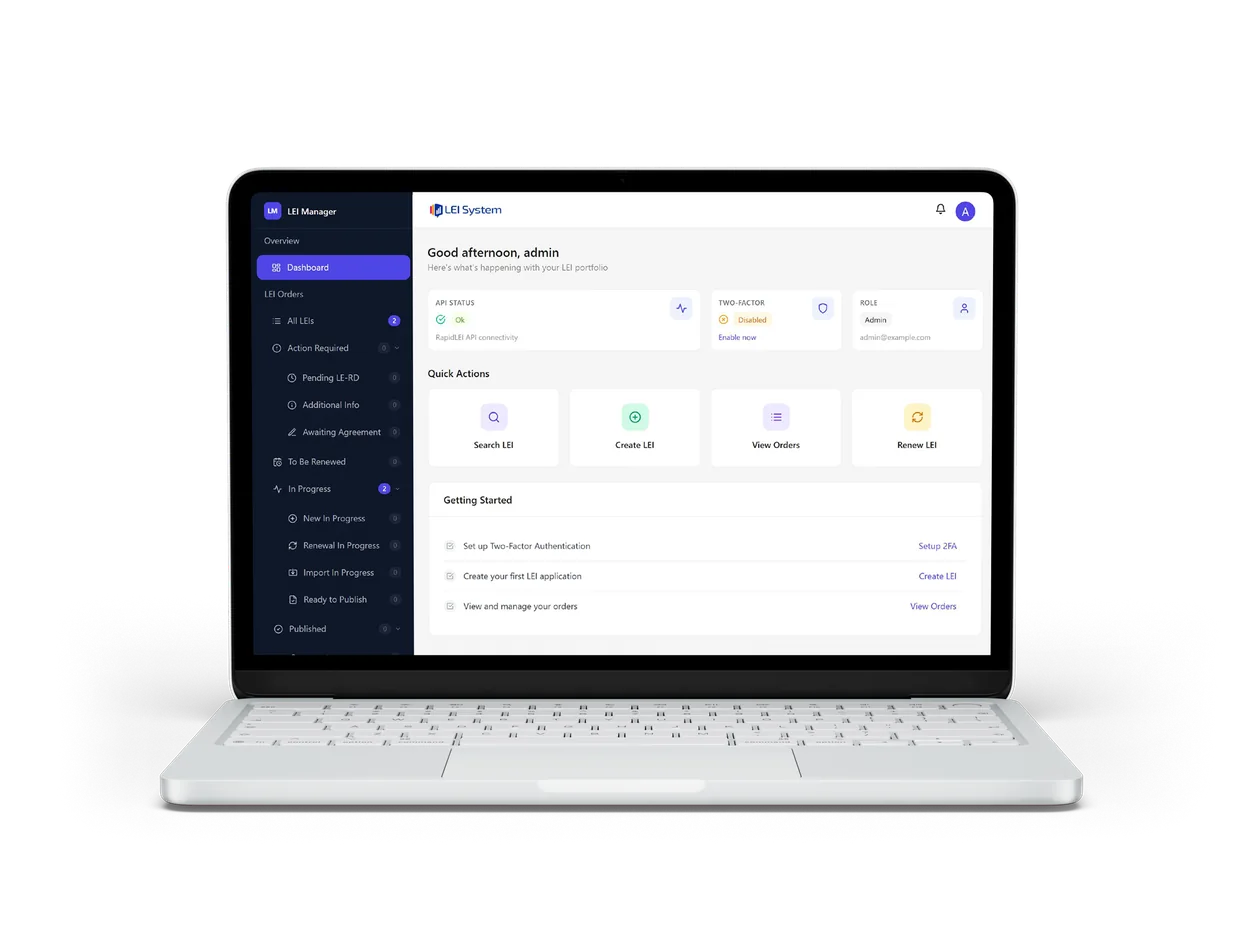
| Tracking hundreds of client LEIs on spreadsheets doesn't scale | LEI Manager's dashboard tracks every code's status and renewal in one place |
Beyond satisfying a regulation, this is where the LEI actually gets used day to day.
Populate the counterparty identification fields in MiFID II and EMIR transaction reports with LEI codes, avoiding the report failures a missing identifier causes.
Look up a new corporate client's LEI to pull verified legal name, registered address and ownership data directly into the onboarding file.
Verifying a correspondent or counterparty bank is a routine part of onboarding, whether that means a bank LEI code lookup for a major institution like HSBC, Citibank, Standard Chartered or Danske Bank, or confirming a smaller regional bank's LEI number is current and ISSUED.
Populate structured party-identification fields in ISO 20022 payment messages with LEI codes, satisfying the Bank of England's CHAPS enhanced-data mandate.
Identify third-party ICT providers in the DORA register using their LEI, the recommended identifier for ICT third-party risk reporting under the regulation.
Confirm a correspondent bank's legal name, jurisdiction and regulatory status through its LEI record before establishing or renewing the relationship.
Banking is one of the most heavily regulated sectors for entity identification, and for good reason: a bank's counterparties span jurisdictions, registries and naming conventions that were never designed to agree with each other.
More than 300 regulations worldwide now reference the LEI, precisely because it replaces that patchwork with one verified, globally consistent identifier that resolves to authoritative source data rather than a name a compliance officer has to manually reconcile.
Regulatory compliance is the reason banks register an LEI. What it changes operationally is the reason it's worth doing properly.
Regulatory compliance is the reason banks register an LEI. What it changes operationally is the reason it's worth doing properly.
A valid, ISSUED-status LEI on both sides of a trade means a MiFID II or EMIR report goes through cleanly the first time, instead of bouncing back for a data-quality fix days later.
Capturing a client's LEI at onboarding pulls verified identity and ownership data from GLEIF automatically, cutting the manual registry-checking work a compliance team would otherwise do by hand.
LEI Level 2 data shows direct and ultimate parent relationships, giving a bank a verifiable answer to “who owns whom” without chasing down corporate registry filings across jurisdictions.
A correspondent bank's LEI record surfaces its legal status and registration details in one lookup, a faster starting point for due diligence than reconciling names across separate national registries.
Five separate regulatory tracks have converged on the same answer, which is part of why LEI compliance in banking isn't a passing trend.
Banks and investment firms must include valid LEI codes for every counterparty in transaction reports; a missing LEI causes the report to fail validation entirely.
EMIR mandates an LEI for both counterparties to every OTC derivatives transaction, with both sides required to hold current, ISSUED-status identifiers.
CHAPS participants have submitted complete, validated ISO 20022 party data since the mandate took effect on 1 May 2025, with LEI population rising sharply once it did.
DORA requires banks to identify all third-party ICT service providers, with the LEI recommended as the identifier for third-party entities in the DORA register.
| Regulation | Jurisdiction | What It Requires |
|---|---|---|
| MiFID II & MiFIR | EU/UK | Valid LEI for all counterparties in transaction reports |
| EMIR | EU | LEI for both counterparties in every OTC derivatives trade |
| Bank of England CHAPS | UK | LEI in ISO 20022 payment messages, mandatory since May 2025 |
| DORA | EU | LEI for third-party ICT providers in the DORA register |
| RBI Circular | India | LEI for large-value transactions above ₹5 crore |
| CFTC Swap Data Reporting (17 CFR Part 45) | USA | Every swap counterparty under CFTC jurisdiction must obtain and use a single LEI in all recordkeeping and swap data reporting. |
| HKMA/SFC OTC Derivatives Reporting | Hong Kong | LEI mandatory for all reporting participants in Hong Kong's OTC derivatives trade reporting regime, in effect since July 2017. |
| MAS OTC Derivatives Reporting | Singapore | LEI required to identify reporting entities in OTC derivatives transactions; 2024 guidance clarified the head-office LEI must be used for branch-booked trades. |
Individual registration works when you need one LEI. Banks rarely stop at one, client portfolios, correspondent relationships and internal entities all need identifiers tracked at once.
LEI Manager is LEI System's platform for exactly that.
Explore LEI ManagerTrack every LEI a bank is responsible for, its own entity, correspondent banks, corporate clients, from one dashboard, with automatic renewal so a client's code never lapses mid-relationship.
Connect LEI registration, lookup and status checks directly into onboarding, KYB and trade-reporting systems via the LEI Manager API, so entity verification happens automatically as part of existing workflows.
Register up to 200 client entities in a single upload instead of repeating the application 200 times, LEI Manager verifies each one against official registries and issues codes without separate validation delays.
Getting registered is a five-minute online process, not a paperwork exercise. Submit your entity's legal name and registration details, LEI System verifies them against official business registries, and your code is issued and published to the GLEIF Global LEI Index, immediately checkable by any counterparty or regulator who looks it up.

Pick a subscription plan and complete the online application with your entity's legal name, address and registration number.


Our system verifies your entity data against official business registries in real time, notifying if additional documents are needed.

Your LEI code is issued, recorded in the Global LEI Index and delivered to your email address along with a confirmation.
Every LEI System plan includes the GLEIF fee, lapse protection, and automatic annual renewal, so a code stays in ISSUED status for every transaction it is used in, not just the first one.

Kristian Hein, November 18
The Financial Stability Board’s 2026 cross-border payments report highlights the UK’s CHAPS system as a live example of how Legal Entity Identifiers are moving into payment infrastructure. CHAPS handles everything from time-sensitive business and property payments to large financial-market settlements. Its financial-institution layer carries 73% of the value settled, making LEI data especially relevant for risk management, compliance, counterparty identification, and automated processing.
Read more
Kristian Hein, November 11
Does a branch need its own LEI, or should it use the head office’s code? Opening a foreign branch does not automatically create a separate LEI requirement. This guide explains the difference between branches and subsidiaries, when reporting rules call for the head office’s LEI, and when a branch may need its own. Find out what to check with your bank, broker or supervisory authority before applying.
Read more
Kristian Hein, November 2
GLEIF and DirectTrust are developing a new digital trust model for US healthcare using LEI and vLEI. The initiative aims to help hospitals, laboratories, insurers, and other organizations verify identities, confirm delegated authority, and establish trust across digital systems. It marks an important step toward expanding the use of LEI beyond financial services.
Read more








 Affordable
 Lapse Guard
 Auto Renewals
 £50 total